
When robots deliver our stuff, we buy 10% more
I'll bet you 100 Substack subscribers you've never heard of the top robot delivery company in the world ...

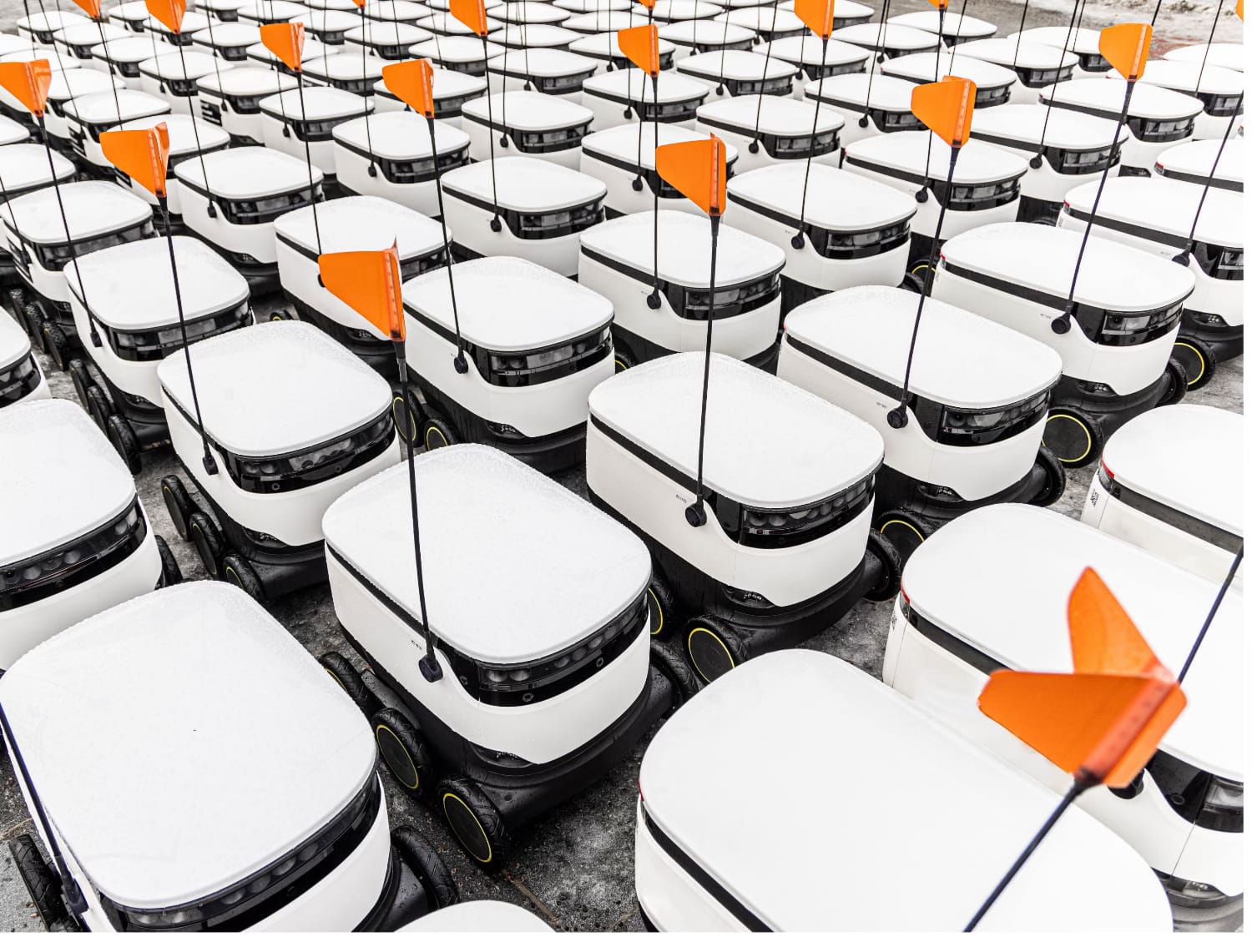
You’ve probably never heard of the company that’s done 5X more robot deliveries than all its US competitors combined. (And no, it’s not in China.)
The company is Starship (no relation to Elon’s big rocket) and it has completed over 9 million autonomous deliveries. Also, it’s just raised $50 million to expand its robot fleet 4X and invade American urban markets and college campuses.
Here’s my chat with the CEO, Ahti Heinla … who just happens to be a Skype cofounder from back in the day:
Unlike experimental drone systems or sidewalk bots in pilot mode, Starship is already commercially viable: profitable per delivery in several countries, operating at Level 4 autonomy, and delivering tens of thousands of packages every single day.
All in this 6-wheeled robot:
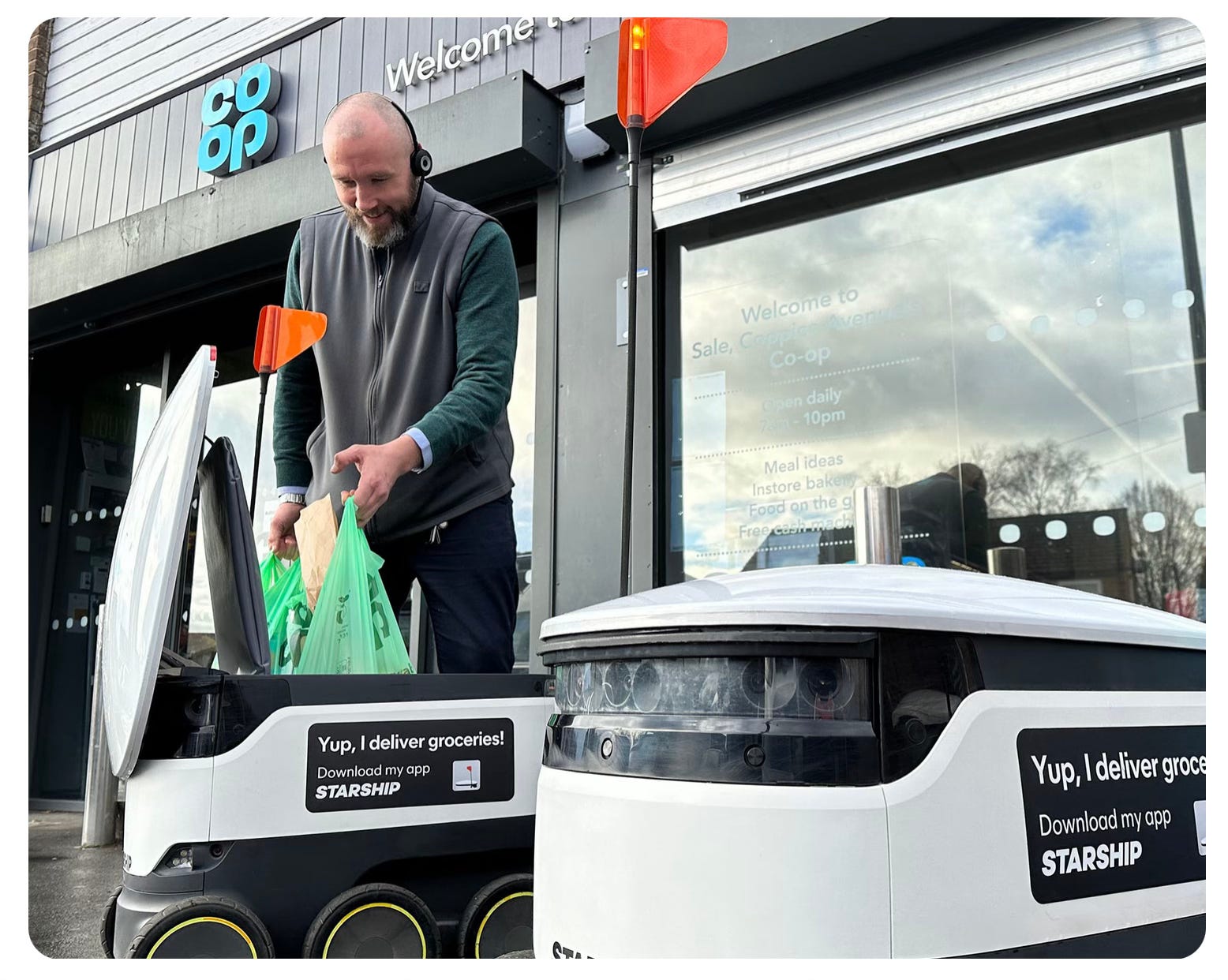
Starships’ robots are about the size of a big cooler on wheels, carry up to 35 kg of cargo, and are insulated so your frozen hamburger patties stay cold. They drive around at about 6 km/hr, don’t need GPS, and run for 18 hours on a single charge. They also don’t live in a house … they just stay out all the time.
For safety, they have 12 cameras, radar, and ultrasonic sensors.
And apparently, they make us buy more. According to Starship, when we order by bot, we buy about 10% more stuff.
(Maybe we just like the robots?)
“Stores see that their revenue, their orders, effectively go up by about 10% or so because people love robots,” Heinla told me. “Now it’s a really unique way to get things delivered to you.”
I mean, the very second drone delivery is available in my area, I’m hitting that Order button like a psychotic lab monkey pushing the MORE COCAINE button. At least for a few days, until the novelty wears off.
But maybe there’s more to it than just novelty.
People actually seem to like these robots, Heinla says.
“People wave to our robots. Kids feed our robots bananas. It’s a little bit of a social phenomenon. People really develop an emotional attachment. For example, it happens quite often that when a robot stops somewhere for a second, somebody around thinks, ‘Does the robot need help? Can I help the robot? Can I give it a little bit of a push?’”
It’s interesting, of course, because they are the same robots that are taking jobs away from delivery drivers and couriers. But no-one ever said humans were logical.
Robots are going to win the last mile of delivery, though.
It’s just inevitable.
Drone delivery is 10% of the cost of a human with a vehicle, the CEO of Manna, an airborne drone delivery company out of Ireland, told me a few years ago. And that’s just a part of the story:
No tipping
No fuel (Starship’s drones are little EVs, and electrons are cheaper than hydrocarbons)
No human wages
It all adds up to unmatched cost per delivery, leading to greater convenience and higher frequency orders.
And it adds up to a new normal. In cities where Starship has been active for years, like Milton Keynes in the UK, Heinla says the robots are now just a standard, normal, boring part of the community. People are getting used to ordering in small, frequent batches instead of weekly hauls, which is changing both consumer habits and retailer realities. It’s a shift in both logistics and consumer psychology.
And they’re acclimatizing to robots as a default part of the urban environment … something that’s not really notable anymore.
The future, of course is more complex.
It’s gonna be land-based delivery robots, sure. And airborne drones for faster delivery of smaller packages: the sweet spot for hot food. And bigger vehicles, probably with people, for the truly big and heavy packages.
Starship — and other bots like it — will probably be normal in most industrial nations urban centers within 5 years.
Pretty soon after that, we’ll stop even noticing them.