
The AI-native factory is here. And it's helping onshore (re-shore?) manufacturing
Hello, mass personalization, as the craft economy meets the industrial revolution

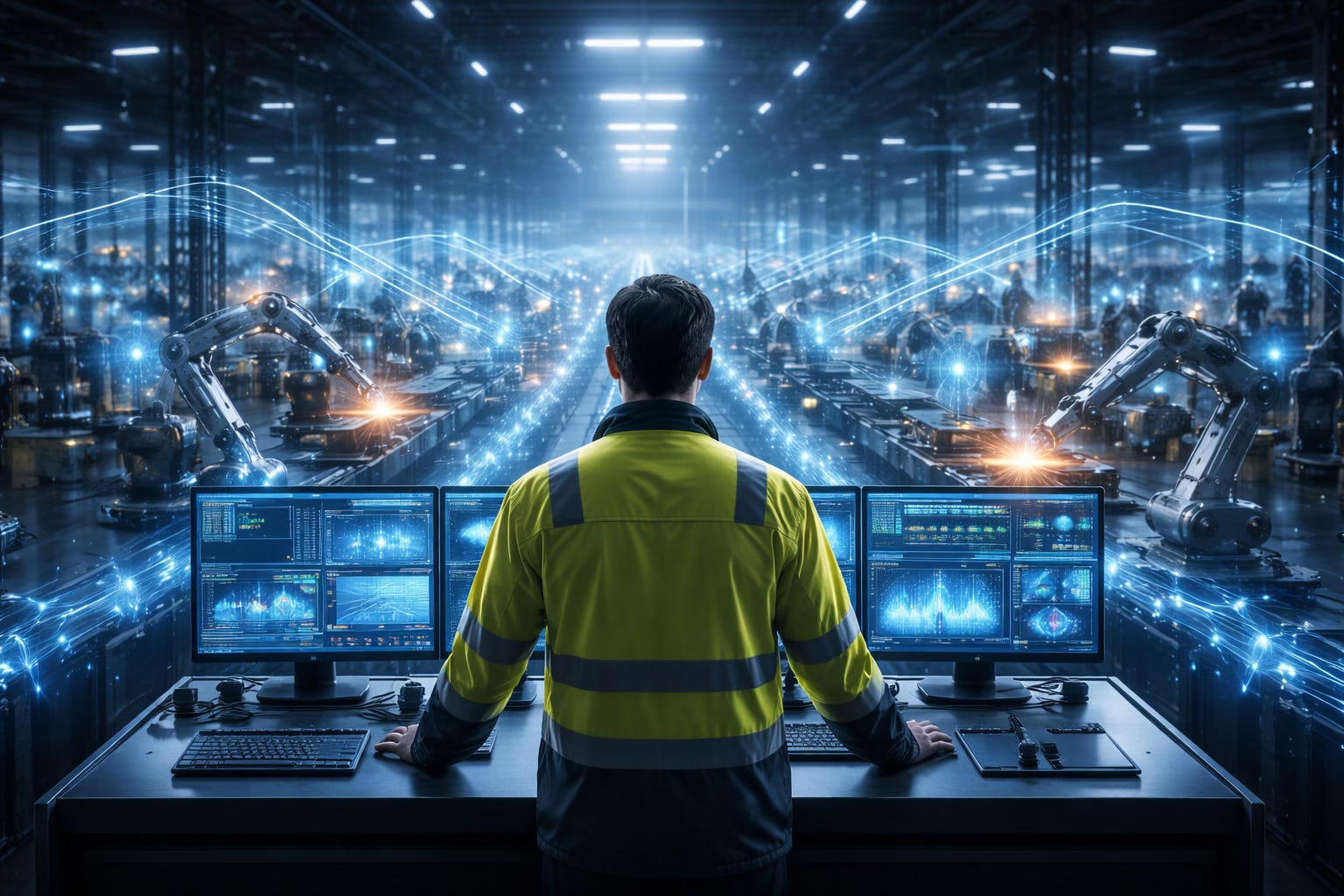
That pic I’m using for this newsletter? Yeah, totally misleading. Because AI in the factory doesn’t mean a factory with all machines, robots, and humanoids doing all the work and AI doing all the thinking.
That’s still science fiction.
We might get there in 5 or 10 years, hopefully with an evolved social consciousness about work, jobs, careers, and universal basic (or abundant) income, but that’s not where we are today, and it’s not where we’re getting tomorrow either.
Today, the AI native factory is event-driven, role-specific, human-accountable, and deeply constrained, all by design.
And the LLMs we all know?
They’re mostly useless.
Check out my recent convo with Angelo Stracquatanio, the CEO and founder of Apprentice. Apprentice is a 12-year-old company that runs manufacturing execution systems for some of the most regulated industries on Earth. Two thirds of all commercially approved gene therapies in the world are produced on Apprentice’s MES. These are drugs custom-made per patient, using their own white blood cells and DNA. And plenty of mass production make-millions-of-them-all-the-same factories run Apprentice systems too. Apprentice is the sponsor for TechFirst for this month.
Check it out here:
Chatbots can’t run factories. So what AI can?
Manufacturing runs on events, not conversations.
And LLMs mostly know words and digital representations, not made-of-matter things like gears and motors and production lines.
Alarms fire. Equipment fails. Materials don’t match specs. Quality exceptions happen. None of these things wait for you to open a chat window and type a prompt.
So Apprentice built what they call A1: an AI agent that responds to manufacturing events autonomously, without being prompted. An alarm triggers an alarm triage agent. A quality exception triggers a quality agent. A troubleshooting situation at 2am triggers an operator agent that doesn’t just give Bob four bullet points: it builds him a visual, clickable, step-by-step guide derived from every relevant SOP in the system.
That’s not AI in manufacturing.
It’s AI-native manufacturing.
So … they had to build their own model
Not shockingly, Apprentice had to build their own AI foundation model. Google makes models. OpenAI makes models. Anthropic. Leading Chinese AI companies.
Usually not a manufacturing process company.
Generic AI gives generic answers. Public models failed on the metrics that actually matter: specificity, consistency, and compliance. That’s not just unhelpful … that’s dangerous.
So they took 12 years of domain knowledge, floor experience, and manufacturing domain data, and fine-tuned their model using reinforcement learning. The result: a model that massively outperforms off-the-shelf options on the dimensions that matter in a plant.
But LLMs are still probabilistic. That means hallucinations are still a possibility.
So they constrained the AI until it can only be useful.
Manufacturing wants predictable, deterministic tech. So instead of open-ended prompts with wide probability distributions, Apprentice built highly constrained workflows with narrow, repeatable steps. An instruction, a connector, a compliance gate, an artifact. The AI follows the workflow, and the workflow produces consistent outputs.
(That’s kind of the manual production line executed in code, no?)
The end result is that there are now bumpers on the bowling lane. The ball still rolls, but it can’t go in the gutter. Plus, of course, there’s human-in-the-loop guardrails at every integration point. Before the agent writes to a system, reads from a system, or creates an output, a human can optionally be required to accept or reject the action … with full source history visible so they understand exactly what the AI did and why it’s recommending what it’s recommending.
The results?
Quality review is running 33% faster. That’s huge, because it’s up to 40% of cost of goods sold for some manufacturers. Plus alarm triage is happening faster. (In fact, it’s actually happening: some factories get so many alerts that line workers tend to start ignoring them, potentially causing catastrophic errors downstream.) An agent doing first-pass triage dramatically reduces time-to-identification of what actually matters.
That matches what I learned from AT&T’s head of AI: agents in network operations reduced triage time to 2% of what it was before … literally a 50x improvement. Angelo sees the same pattern on factory floors.
People still in the plant
I threw Angelo a quote from an 1979 IBM training manual that’s been making the rounds lately: “A computer can never be held accountable. Therefore, a computer must not make a management decision.”
He didn’t flinch. He agreed.
His view is that humans remain accountable. Period. AI is a tool that dramatically increases what a human can accomplish, not a replacement for the human who has to answer for the product.
The result: on-shoring or re-shoring becomes possible
Here’s where it gets geopolitically interesting.
U.S. tariffs are forcing a lot of western companies to think about onshoring or nearshoring or re-shoring production. The math is not kind: US and European labor is expensive. So how do you compete with a facility in a lower-cost country?
Angelo’s answer: compress your COGS with AI until the economics work.
Raw materials and CapEx on physical equipment? AI can’t really help you there. But the third layer — labor utilization and asset utilization — is where AI hits directly.
Bob and Susan still move their hands. But Susan and Bob also do a lot of other things: reviewing paperwork, running troubleshooting, analyzing data, processing quality exceptions. That’s where AI takes over. Hands stay busy doing what hands do best, everything else gets automated.
The same applies to equipment: better alarm triage, faster troubleshooting, smarter analysis of line performance … all of it pushes throughput up without changing the hardware.
If you can compress COGS, the competitive advantage of manufacturing somewhere else shrinks.
That’s not a silver bullet. But it’s a real possibility, and a real path.
Especially when you have not 5 products but 5,000.
5,000 products and the adaptive factory: the craft economy meets the Industrial Revolution
The manufacturing nirvana everyone talks about is high-volume, zero-defect, perfectly repeatable production.
That’s hugely important. But that’s not where the entire world is heading.
We’re seeing more and more demand for personalization at scale. More SKUs. More product variants. Custom medicine made per patient from their own cells. The next step, as Angelo sees it: the adaptive plant. Not just automated, but capable of reconfiguring itself for new products, new variants, new manufacturing processes.
AI as a personalization layer, not just an automation layer.
That requires new equipment, new hardware, new robotics. Apprentice is one piece of the puzzle. But the vision is pretty clear: a factory that learns, adjusts, and produces personalized products the way today’s factories produce commodities.
In other words, the craft economy meets the Industrial Revolution.