

18 months ago Foundation launched. Today, they’ve already got a humanoid robot doing actual work in customer facilities. This year, they plan to ship 40 or 50. Next year, they want to scale to 10,000 units. And by 2027, CEO Sankaet Pathak told me he wants to ship no fewer than 10,000 humanoids.
Insane right?
Except that their head of manufacturing helped Tesla scale for the Model Y ramp to over 2.5 million units.
But this is not the most shocking thing about Foundation.
That’s their explicit military intentions.
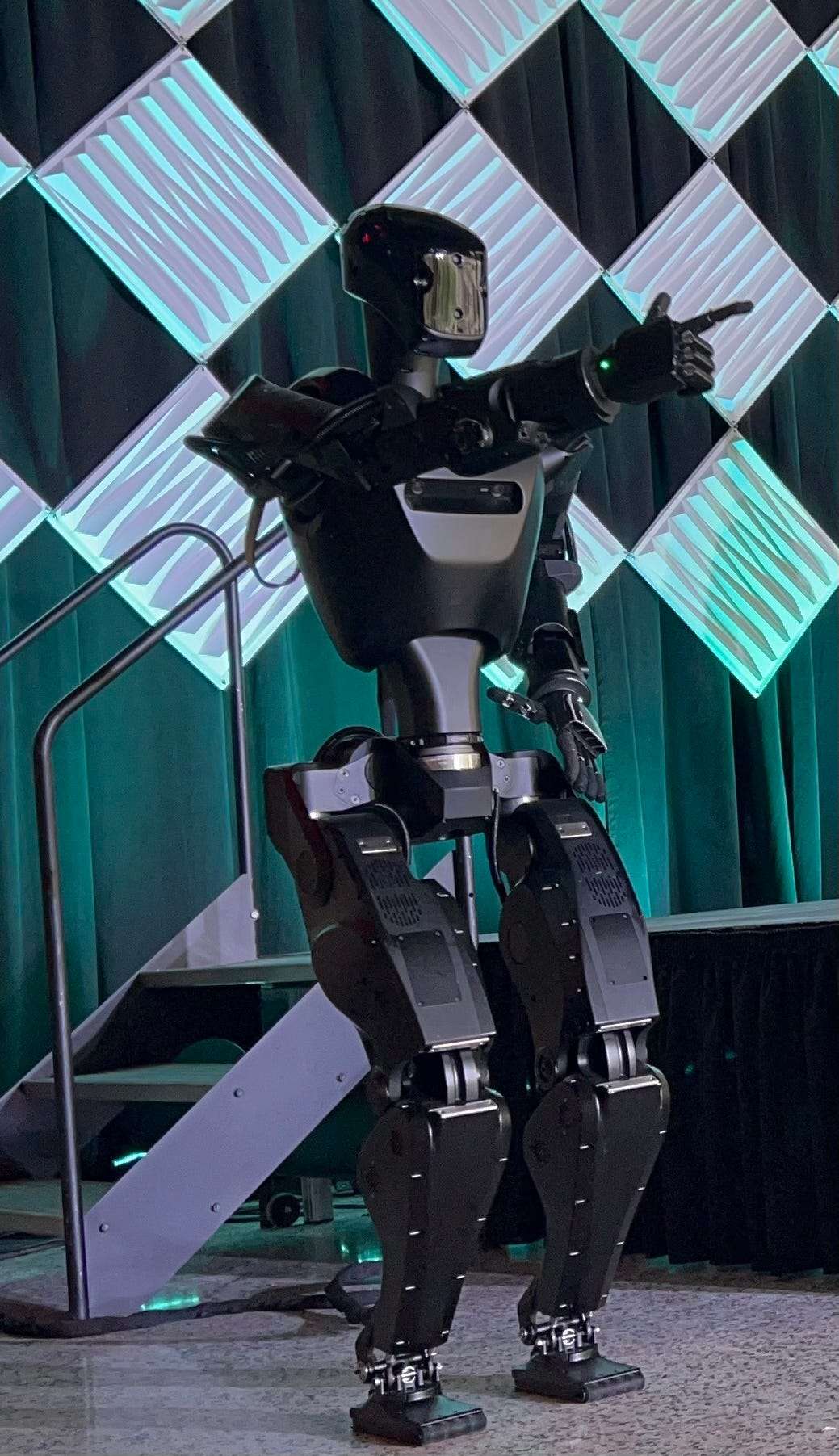
Part of those military intentions are helper roles, potentially non-violent. “There are so many scenarios where soldiers put themselves in harm’s way because they’re the first body into a situation and they don’t really know what that situation is,” Pathak says. “I think robots are much better suited for that and should do it.”
Others are explicitly weaponized.
Humanoids in combat need to be armed and dangerous, he said, or they won’t be able to accomplish their missions.
“If you’re first body in and you’re docile, then the enemies are not going to expose themselves. So you have to be first body and deadly.”
Sankaet Pathak
And having a large fleet of humanoid robot soldiers, Pathak says, could even be a massive peace-keeping project.
Why?
Potential enemies know that the U.S. would much rather waste material than lives, and so would be more likely to enter conflicts rather than sit on the sidelines. The nuclear deterrent works for large nation-states. The robot soldier deterrent, in this view, works for non-state actors and smaller countries.
“I do think the way to not get bullied is to be like, okay, I think I’m going to get beat up if I bully this person. If the U.S. military had 100,000 robots that they could just demonstrate working, it would, by and large, end a lot of wars before they start.”
Sankaet Pathak
Maybe.
Or maybe the U.S. — or any other nation with large numbers of humanoid robot soldiers — would be more likely to get involved in non-nuclear conflict because there will be no grieving widows and mothers.
And, let’s not forget, China has 150 humanoid robot companies to America’s 20ish. And arguably superior manufacturing capabilities.
That’s a scary future … and one in which humanoid robots could just as easily be deployed against civilian populations.
More than war
Of course, there’s much more than war to Foundation’s story.
Pathak wants to use robots to colonize uninhabited places on Planet Earth, for one (including Antarctica) and Mars, for two. (Where else have I heard that?!?)
He’s also looking to deploy them in America to re-industrialize and on-shore manufacturing with the potential scale that “infinite labor” promises.
In reality, he says, we have not ended slavery … we just offshored it. The new face of bondage, in his opinion, is corporate slavery: supply chains where people in low wage countries perform hard, boring, and dangerous work for very little pay so that richer countries can benefit from cheap goods.
In this thinking, if robots can take over the work humans do not want to do, especially in unsafe or punishing environments, then we can remove the economic incentive for those systems. And if robots can build and maintain infrastructure anywhere, we can populate more of the planet rather than cramming into coastal cities.
There’s lots to unpack there, of course.
Just for one, people may hate their jobs but still want them if they don’t seen an economic structure to replace them that retains an ability for their to earn a living.
The robot itself: Phantom
Foundation (and yes they got their name from the Isaac Asimov series that features robots) named their robot Phantom.
Bigger Asimov fans might have named him Daneel, but Phantom looks like a typical humanoid robot at first glance. It’s roughly human height and weight, around 1.75 meters tall and about 80 kilograms, and it can carry a 20 kilogram payload with plenty of margin.
What is different is under the skin.
Foundation has built its own actuators, the motors and gearboxes that serve as the robot’s muscles. They are:
Fully backdrivable: you can push against the motion, and the actuator yields instead of fighting you.
Highly efficient: around 95 percent efficient, compared to 40 to 45 percent for many industrial actuators.
Low friction and low heat: they dissipate very little energy as heat, reducing wear and extending lifetime.
That combination matters for several reasons:
Backdrivability and compliance make the robot safer to work around. People in the factory can physically interact with Phantom. It does not “whack back.”
High efficiency means more torque at the joint for the same motor, so you can get more strength without making the robot huge.
Low friction and low heat mean the robot can run much longer without overheating.
Pathak says Phantom is already running three shifts a day, essentially 24 hours a day, five days a week. Right now those robots are tethered to power, since they are operating in relatively small cells. The limiting factor is not battery, it is thermal and mechanical robustness, and Foundation has designed for that.
The trade off is that ultra smooth, low friction gearboxes have more “backlash” than traditional industrial actuators. They are slightly less perfectly precise at hitting exactly the same point over and over. In a camera centric, vision first robot, however, that is a solvable problem, Pathak says.
Not for homes
Interestingly, Pathak is not sold on the vision of humanoids for homes.
People do not want a full size humanoid presence wandering around their houses, especially around kids and pets, he argues. For home use, he says, robots need to feel completely safe, not just be safe, be non-intimidating and mostly invisible, and interact with the physical environment only when needed, then fade away again.
The solution that fits this description, he feels, hasn’t been built yet.
So while Foundation may eventually build something for the home, it probably will not look like Phantom.
Back to war
This is the first humanoid robot manufacturer that I’ve seen that explicitly calls out a future military use for humanoid robots. With what we’ve seen around drone and robot use in the Russia-Ukraine conflict, we’d be fools to presume others won’t do this as well.
Guaranteed the Chinese government is thinking along these lines.
The future of war might be very much like a very deadly real-life video game. The model he expects is similar to drones today:
Robots are autonomous on “how” they move, navigate, and position themselves.
Humans remain in charge of “what” to target and when to use lethal force.
That implies a future where war looks more like eSports, with human operators directing robot bodies on the ground and in the air, and machines executing the physical actions.
In other words, less first-person shooter than strategy games.
That’s pretty unsettling, but we’re already been seeing it for years with Predator drones.


