
Just maybe, the robot you actually want isn't a humanoid
Colin Angle has shipped more home robots than anyone alive. His new bet: half the $5 trillion physical AI market has nothing to do with physical work.

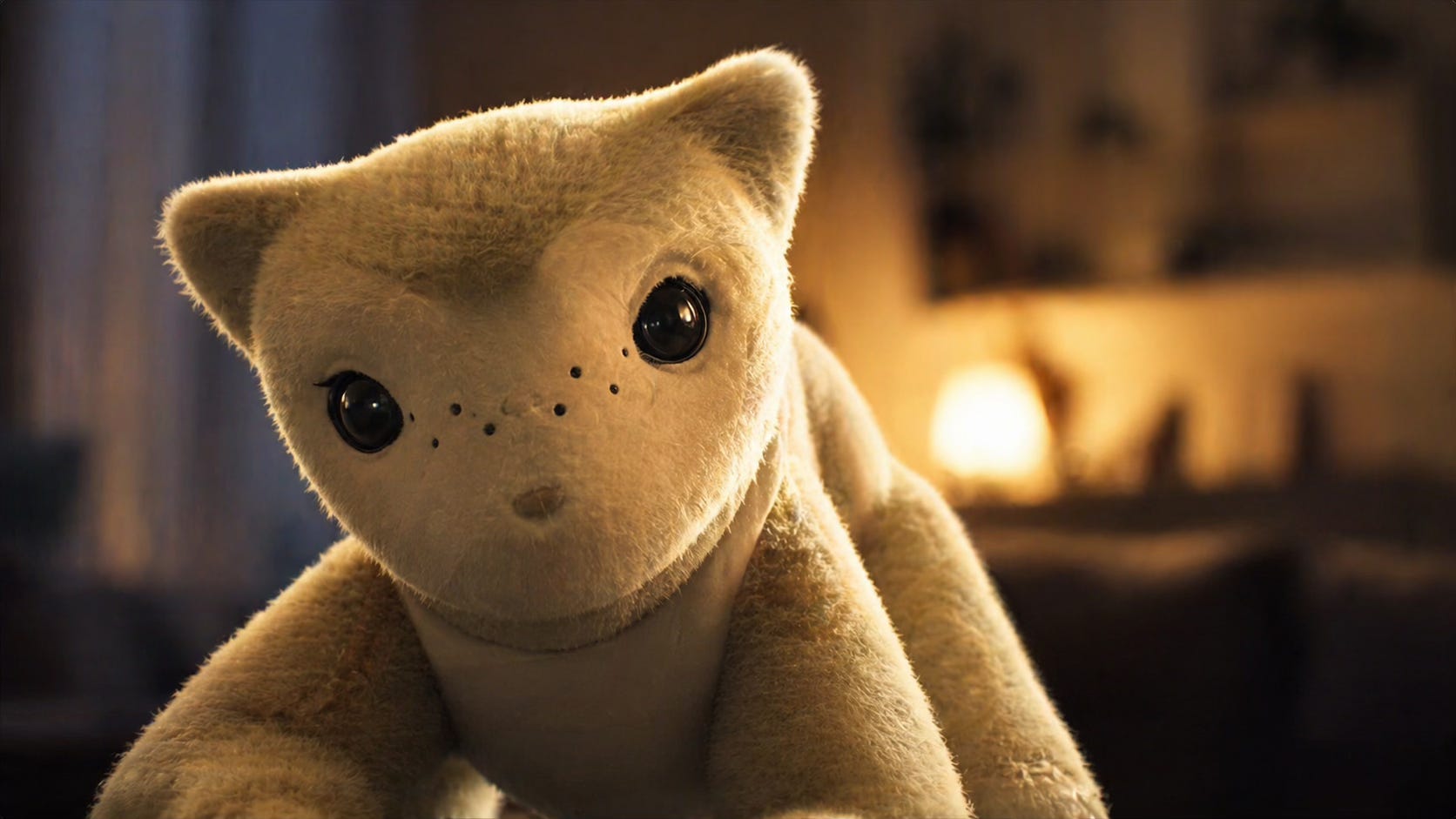
You probably didn’t know you needed a robot dog to do yoga with. I didn't know that.
But the man who has shipped more robots into homes than anyone alive is betting that half the projected $5 trillion physical AI market will be for companions, not drone-like machines that just do work.
That dog, btw? It’s a quadruped, not a dog.
Maybe closer to a bear than a canine, doe-eyed, fuzzy, with a touch-sensitive coat and 23 degrees of freedom. It can follow you into the kitchen while you cook. It can hang out next to your kid while they read. It can nudge you off the couch when it notices you’ve been doomscrolling for 45 minutes.
It’s called a Familiar. And the company building it just came out of stealth.
Subscribe to the TechFirst YouTube channel to never miss an episode
Or listen on Spotify or Apple Podcasts
This episode of TechFirst is sponsored by Apprentice
Did you think AI was only for digital work? Nope … AI-native manufacturing is here. This month’s sponsor is Apprentice, which offers the first AI Agent built from the ground up for agentic manufacturing. Connects to all your systems, monitors everything, automates all your processes … but keeps a human in the loop. Check it out at apprentice.io.
Watch our conversation here:
The detour that became an industry
When Colin Angle cofounded iRobot in 1990, the company was originally called Artificial Creatures, Inc.
Roomba, the disc-shaped vacuum that put more than 50 million robots into homes worldwide and effectively created the consumer robotics category, was not the dream.
It was the detour.
“I’ve been thinking about robots that have more human interaction than just floor vacuuming for a very long time,” Angle told me on a recent TechFirst episode. “Now I get to actually do it.”
Yesterday at the Wall Street Journal’s Future of Everything conference, Angle brought his new company, Familiar Machines & Magic, out of stealth. The first product won’t ship until next year. But the thesis is pretty provocative: Angle isn’t just launching another home robot … he’s arguing that the entire humanoid robotics industry is fighting over the wrong half of the market.
The other $2.5 trillion
The physical AI gold rush has been almost entirely about work. Industrial work, logistics work, home work (you know what I mean).
Figure, 1X, Apptronik, Agility, Unitree, Agibot, Tesla: they’re mostly chasing factory labor, warehouse logistics, and a humanoid that can fold your laundry. (I want a robot chef, personally.)
I’ve covered most of these companies. The total addressable market gets quoted at roughly $5 trillion over the next two decades. I’ve heard higher.
Angle’s pitch is that half of that — $2.5 trillion — has little to do with physical work.
Instead, it’s emotional work … relational work. The kind a fuzzy quadruped just might handle better than a six-foot-tall humanoid walking into your living room.
Our expectations are higher when we see a human figure.
“As soon as you bring people into the equation, it gets complicated,” Angle told me. “If I had a smart speaker that looked like a puck, I expect to be able to talk to it. I don’t expect it to move across my floor and pick up books. But if I took the same thing and made it look like a humanoid, well, all bets are off. Can it talk to me? Does it have emotions? Can it clean up my room? It’s like, no, it’s a smart speaker. But you’re a humanoid, you should do all these things.”
A humanoid in your living room implies it can do everything — or most things — a human can do. Of course, right now, it almost certainly can’t. (That will change over time.)
On the other hand, a quadruped that looks like an abstract bear sets no such expectation.
“We didn’t want to be a dog. We didn’t want to be a cat, because people have a lot of preconceptions about dogs and cats,” Angle said. “So we chose abstract bear. Can it climb stairs? I don’t know. You can say, ‘Colin, does it climb stairs?’ You can say, ‘I don’t know.’”
The price-to-pet thesis
FM&M isn’t disclosing pricing yet. But Angle gave me the framing he’s working backwards from: cost of ownership equivalent to a pet.
“If you can afford to own a pet, you could afford to own a Familiar,” he said. “Some of the people most enthusiastic about owning a Familiar are pet owners.”
This is the iRobot magic trick. The one that basically no consumer robotics company since has managed to pull off. And the one that will make or break this new robot category. Roomba succeeded not because it was the most capable robot — though it was for a while — but because it found the price-to-utility sweet spot in a category that people frequently do, hate doing, and already spend real money on.
Companionship, loneliness, and elder care are different.
People spend a lot trying to find a little joy and a little connection in their everyday lives.
“It can learn your schedule. It can notice, hey, you’ve been doomscrolling for like 45 minutes — how about we go take a walk?” Angle said. “At its core, it’s not really trying to be a companion. It’s trying to get you out into the world so you can meet other people.”
This won’t be easy, though
Whether Familiar Machines & Magic can pull this off is genuinely uncertain.
Consumer companion robots have a roughly 100% failure rate to date. The hardware is hard. The AI is hard. The unit economics on a quadruped that walks alongside a human are hard.
But the biggest question isn’t whether FM&M will or will not succeed.
The biggest question is whether Angle is right about the shape of the market.
Because if he is … if half of the physical AI opportunity actually lives outside the factory, in the messy, low-margin, expectation-laden world of human emotional life, then the entire humanoid arms race is fighting over the just half of the prize.
And the company that figures out the consumer side first might not look anything like Figure or 1X or Tesla’s Optimus. It might just look like an abstract bear.
I’m still betting on the humanoids.
But there’s probably room for a few bears, too.