
AI agents operating robots doing physical work ... welcome to the hydrogen bomb for jobs
Yeah, I think the title says it all ... WestWorld in the real world

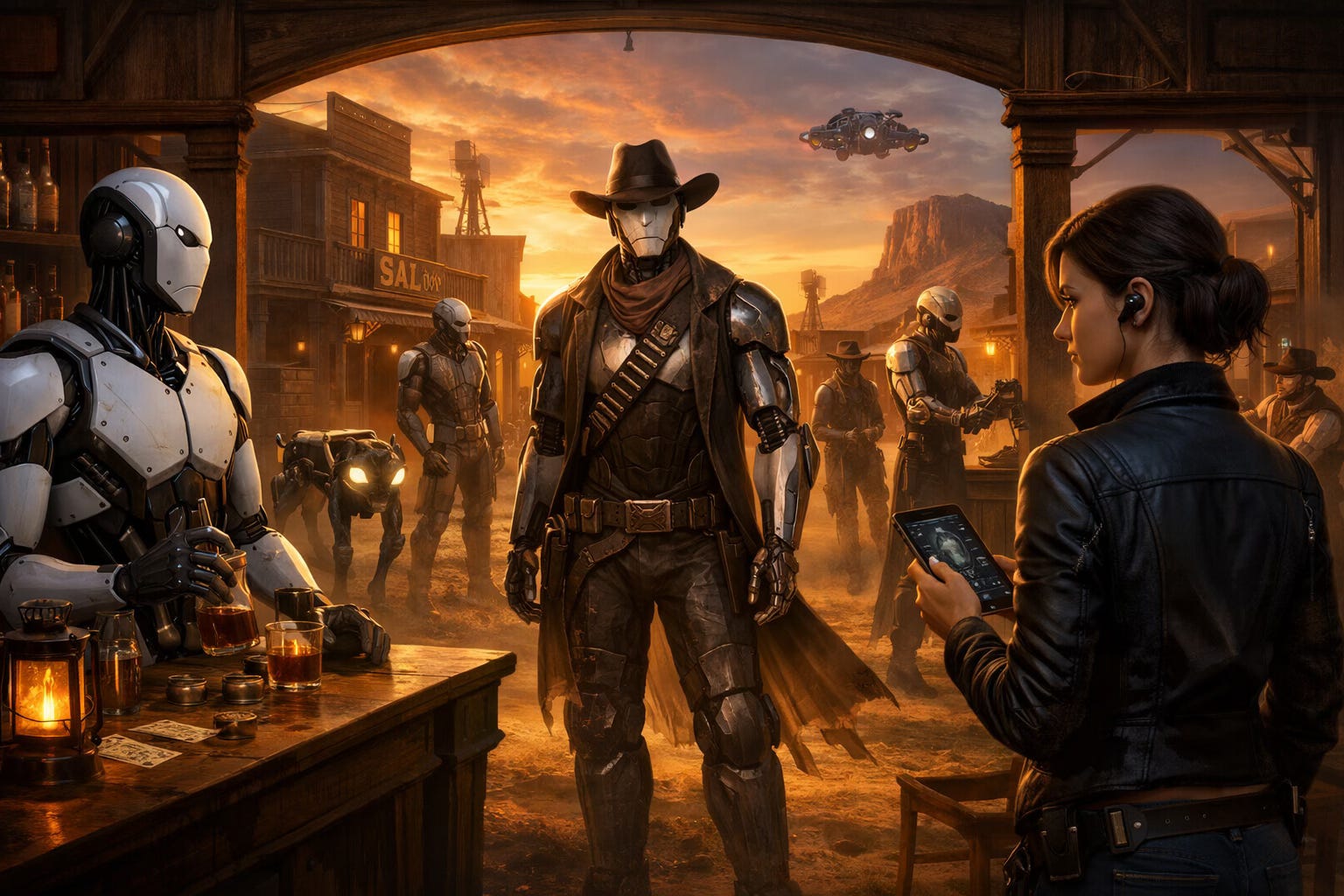
Is your AI agent operating a humanoid robot to build airplanes in France while you sleep?
If not, you might just be living in the past.
That’s the intentionally-hyperbolic opener to my recent TechFirst with Jansen Teng, CEO/cofounder of Virtuals Protocol.
He’s connecting agents to robots … so AI agents are gonna start doing doing real physical work in the real physical world … setting us up for a future where “digital labor” doesn’t stop at spreadsheets and customer support and funky generated AI images.
These are agents that show up in the physical world. Doing real-world jobs. And that means that AI isn’t just coming for white-collar jobs like the Citrini Research thought experiment that went viral this last weekend. It’s coming for blue-collar jobs too.
Check it out:
The big idea: a hybrid economy of humans + AI agents + robots
Virtuals isn’t pitching “cool assistants.” They’re pitching a society layer.
Teng frames it like this: what if a society with 1,000 human founders and 10,000 AI agents (digital or physical) could create more economic output than countries with millions of people?
That output has a name in the Virtuals economy: “agentic GDP.” According to their website, Virtuals has already facilitated:
$14B in tokenized asset trading
$30M+ raised for founders
100+ live AI agents
$500M in “agentic GDP”
Whether you buy the framing or not — or the possibility, at this point in time — the ambition is clear: they want coordination, ownership, and payments infrastructure for an economy where agents do the work.
And now they’re adding bodies.
Robots break the “digital-only” ceiling
Virtuals started in the digital agent world, obviously. The name is a big, unsubtle hint. But Teng says there’s a missing dimension: if digital agents can interact with physical agents, you unlock an entirely new economic surface area.
So they’re expanding into embodied AI with EastWorlds, described as a vertically integrated robotics incubator with 30 Unitree G1 humanoids in a 10,000 sq ft lab.
The vibe is explicitly Westworld-inspired, but when I mentioned that Westworld is a dystopia to Teng, his reaction was kind like John Wick when the fake priest tells him that the mob boss will kill him if he lets Wick into the vault:
“Uh huh.”
In other words: true. And … that doesn’t stop technology.
Teng says full autonomy is still a year or two away for meaningful commercial action, but there’s a big gap we can exploit now: teleoperation. Translation: humans remotely operate robots, which lets you:
deliver useful physical work before autonomy is solved
generate the closed-loop data robots need to learn physical tasks at scale
In other words, we’re explicitly training our replacements by turning the real world and real jobs into training data for future automation. Which is pretty much a hydrogen bomb for the labor market.
At least, it’s a lot more significant than dancing robots.
If you teleoperate, you essentially do wage arbitrage, Teng says, via cheap labor in low cost of living areas or countries. Think robot security guards with human riders, maybe 1 to every 5 or 10 robots. Or mechanics in Argentina fixing your car in Calgary via a Figure robot.
After labor: tokenized ownership as a proposed answer to inequality?
But even that labor arbitrage is a temporary training state. What happens with AI does all the knowledge work and robots do all the physical work? How do people live, eat, and play without jobs?
(Or, at least the kinds of jobs we see today.)
Straight up: in a world where agents and robots do the work, humans need a way to earn income. As I said in the podcast:
“You’re an owner or you’re nothing.”
Teng’s answer for this is tokenization.
The argument is that tokenization lets ownership get “sharded” into tiny pieces, so people can be micro-owners of productive agents, similar to stocks but potentially more accessible.
Is that the solution? Maybe.
Will it work for everyone. Definitely not.
But it’s at least an attempt to answer the question Westworld never cared about: what happens to the humans who don’t own the park?
My thinking: what a “job” is will have to massively shift over the next decade, and how we reward currently unpaid labor (raising kids, visiting elderly people, caring for the lonely, cleaning up a park) will have to massively change.
The big question is: will be able to build the social and political capital to make it happen?